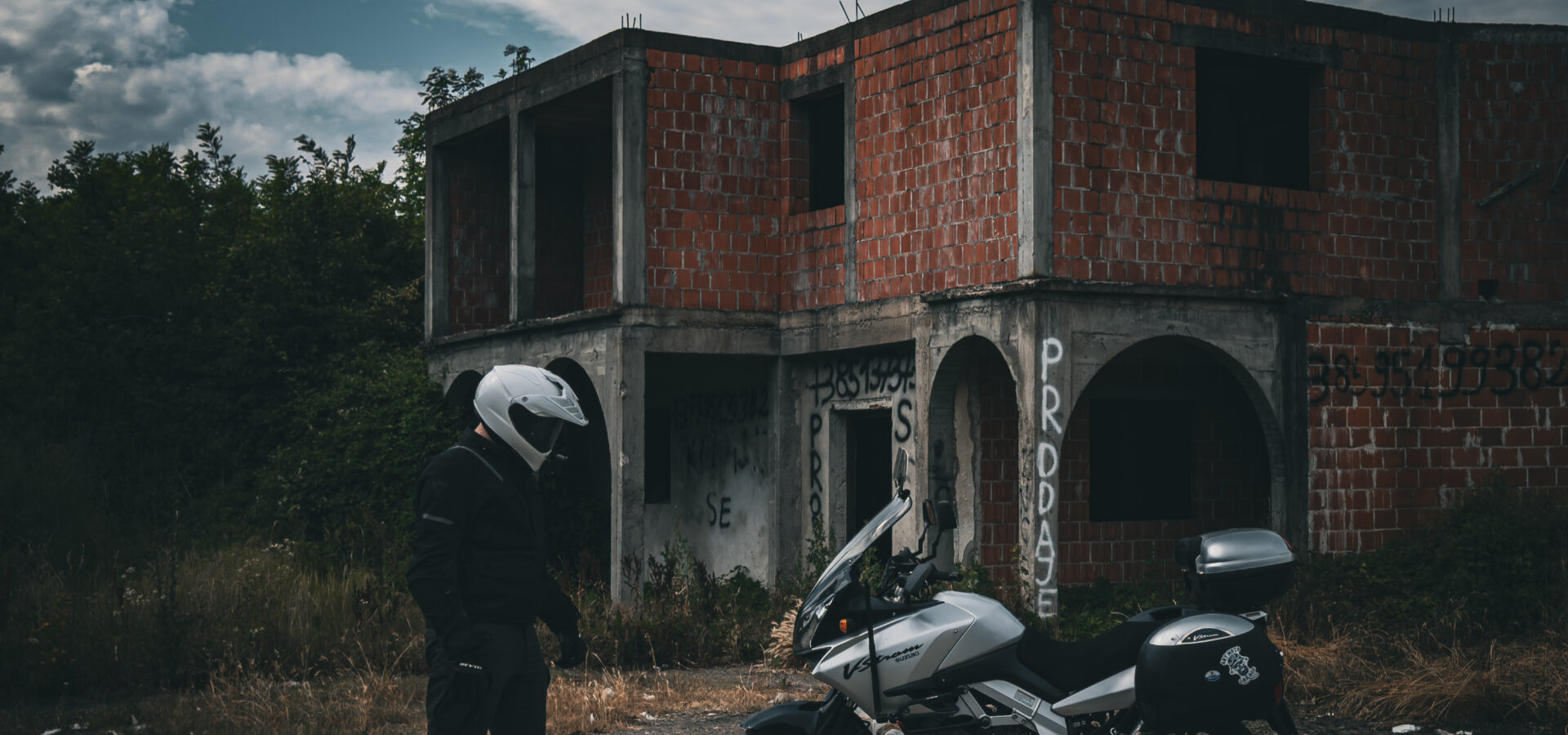
The plan started simply enough: a friend had emigrated to Bulgaria, and that seemed like a good enough reason to ride there from Lithuania. Slovakia, Hungary, Romania, Bulgaria, Ukraine and back — thirteen days, one motorcycle, my wife on the back.
The motorcycle was a Suzuki Bandit 1200s. Old, honest, loud. No windscreen to speak of. It had done nothing to deserve what I was about to put it through.
Day 1–2: Poland and the Tatras
Poland is a country you drive through. We stopped every 150km, the odometer ticking up like Super Mario collecting coins, and arrived at Štrbské Pleso in the Slovak High Tatras by evening. The plan for the next day was serious hiking — up to Chata pod Soliskom by cable car, then a full day in the hills.
What we got instead was rain. Persistent, horizontal, mountain rain that starts when you’re already halfway up and doesn’t apologise. We took the cable car, took some photos, and walked down through it. By the time we reached the town, we were getting the full experience. The rain gear from the bike panniers turned out to be a good idea.
Hiking plan abandoned. Rest day achieved anyway.
Day 3: Budapest, a Broken Frame and a MacGyver Neighbour
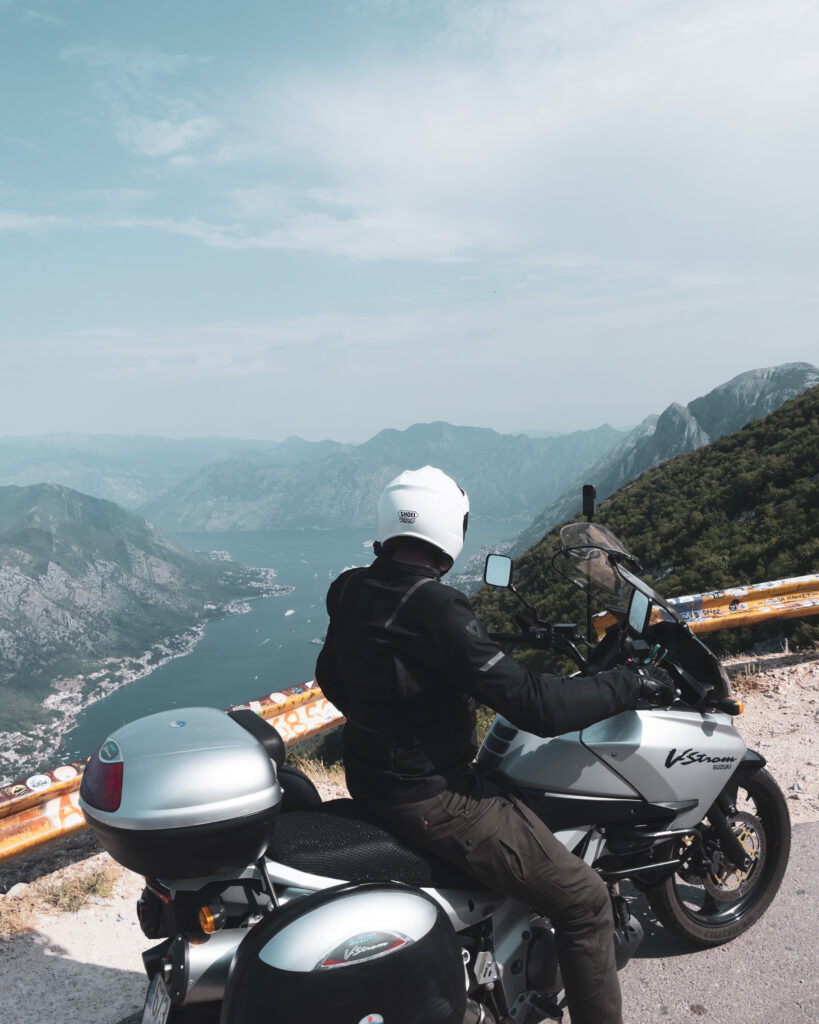
The original plan for day three was a hike through Slovenský raj national park, then Hungary. The rain killed the hike again. But before we’d even loaded the bike, I found something worse than rain: the rear luggage rack was wobbling. A mounting bolt had sheared — and taken a piece of the frame with it.
I decided to ignore this and deal with it in Budapest, where the hotel would have an English-speaking receptionist who could point me toward a garage. Sensible plan.
We rode through the Low Tatras on roads that switched between perfect asphalt and rough gravel patches without warning, me trying not to hit any bump hard enough to finish what the bolt had started, the Bandit somehow returning 300km to the reserve on 19 litres at a steady 110. Somewhere mid-Slovakia we spotted a castle on a hill and detoured. There was a restaurant. We ate.
Forty kilometres outside Budapest, at a petrol station, a man on an identical Bandit pulled in, looked at my bike parked in the lot, looked at me, and said in English: “Do you need help?”
He called someone. Gave me an address. Said they were expecting me.
The address looked like a house. No sign, a grated door, nothing to suggest motorcycle repair. The old mechanic — no English, but very expressive hands — pulled the plastics off and started working on the bolt. I noticed the cracked frame before he did. When I pointed it out, his face did the thing faces do when they are trying to find a polite way to say this is a serious problem. Various sounds followed. He picked up his phone.
Two minutes later he came back with his neighbour. The neighbour was wearing flip-flops, board shorts, no shirt, and had long hair. He looked like someone from a California surf documentary. He looked at the crack, nodded once, and told me to push the bike ten metres down the street to his workshop.
He welded the crack in ten minutes.
Back at the mechanic’s, the bolt was replaced, the plastics reassembled, the bare metal touched up with paint. When I asked how much, he said nothing. I forced twenty euros into his hand and still don’t know if it was enough.
Budapest in the evening. Worth it.
Day 4: Romania and My First Crash
Hungary, in fairness, is beautiful if you like roundabouts. We rode the back roads. There was a roundabout every ten kilometres, without exception, on roads that were otherwise perfectly straight. The Lord of the Rings, I named that day. Tolled it and moved on.
We crossed into Romania around midday. Normal border — documents checked, nothing dramatic. Twenty to thirty kilometres inside the country, on a road through a small village that was just widening from one lane to two, I decided to overtake a minibus.
I could see the road clearly ahead. Lane markings, plenty of space. Clean manoeuvre. Except between the two lanes there were low plastic dividers — about five centimetres high, the kind they put on new roundabouts in Lithuania — and I hadn’t seen them.
I remember noticing them at the exact moment they were unavoidable. I remember thinking: maybe the bike will just ride over them.
It didn’t.
My first crash. I felt the burn as my jacket sleeve rode up and the road introduced itself to my elbow. Then the rotation, the sky-tarmac-sky sequence that you watch in MotoGP slow-motion replays except this time it was happening to me and at somewhat lower speed.
I came to a stop. Looked at my wife first — she was already standing, one hand on her back where she’d caught a kerb on the way down. Bruised. Sore. Alive.
The Bandit had a bent indicator and a collection of new scratches it hadn’t had before. People stopped. Someone called a biker contact locally. We got the bike upright, confirmed everything still moved that should move, and rode on to the hotel.
That evening we sat quietly and considered our options. The motorcycle worked. My wife was sore but not injured. The ride continued.
Day 5: Transfăgărășan
I didn’t sleep well. Post-crash paranoia is its own specific experience — not fear exactly, more a heightened sense of everything that can go wrong. My wife was moving carefully. I felt like an idiot.
We took the motorway to the Transfăgărășan rather than the back roads. Not the most interesting choice, but not the day for heroics either. As the mountains got closer, a different kind of paranoia kicked in: the road was officially closed, we were far from anywhere, and whatever happened up there would happen slowly.
We got past the gates. We were not alone: Czech tourists on foot, construction workers, and — turning a hairpin in the middle of a mountain pass — a shepherd moving a flock of sheep down the road. Three hundred sheep on the Transfăgărășan, completely unbothered by motorcycles or consequences.
The northern approach is good. The southern descent is not — broken, patched, the kind of surface that teaches you exactly how much weight your rear luggage rack is carrying. Romanian drivers doing 90 in 50 zones treated the road as a personal philosophy. Rain approaching Bucharest.
The hotel was in a residential district that reminded me of Perkūnkiemis in Vilnius, except the entire apartment block and surrounding yard apparently belonged to one man, who had decided the open courtyard constituted private parking. I locked the bike and fell asleep in under a minute.
Gear note: the Hevik trousers survived a road crash, a week of hard riding and repeated downpours with nothing worse than a few small holes. The Polish jacket came apart in the Transfăgărășan rain like it had been waiting for an excuse.
Day 6: Bucharest to the Black Sea
Plan: leave at six. Reality: left after eleven. Bucharest in morning traffic is not a city that rewards optimism. Navigation took us through the centre — one-way streets, cars parked wherever physics allowed, forty-degree heat and the kind of horn usage that suggests a deeply held philosophical position on the purpose of the horn.
An hour to get out of the city. Then a long, straight road south to the Bulgarian border.
The Giurgiu-Ruse bridge across the Danube. I had not been prepared for the Danube. The Rhine, the Oder, the Vistula — these are rivers. The Danube at Giurgiu is an inland sea wearing a river’s name. I sat in the traffic queue on the bridge and just stared at it.
Bulgaria checked everyone thoroughly. We joined the queue, watched two Czech riders bypass it entirely, confirmed from them that no vignette was needed, and moved on.
The road through northern Bulgaria turned interesting as it got hillier. Somewhere in the countryside I noticed ruins on a sandstone cliff and pulled over. Belogradchik — medieval fortifications built directly into rock formations that do most of the defensive work on their own. Three euros entry. Worth it.
The last stretch into Burgas undid everything: wavy, patched, a rhythm that transferred directly through the frame into my recently-crashed back. I started to worry about the rewelded rack.
Pomorie. All the seafront restaurants were mostly empty. Except one — Omar — which had a queue outside on both evenings we were there. Three beers, two enormous hot dishes, dessert: eighteen euros for two. The queue was worth it both times.
Day 7: Rest Day, Pomorie
The beach. Sunburn I will not describe in detail except to say my stomach achieved a colour not found in nature. One full day of doing nothing — which, after six days of Romania and everything Romania had contained, was exactly the correct decision.
Day 8: Sofia
Roads E773 and E871 south through Bulgaria. The first two hundred kilometres run through a valley between two mountain ranges — wide, straight and genuinely beautiful in a way that snuck up on me. Endless vineyards, mountains on both sides in morning haze. It reminded me of Tuscan documentary footage, except the road was better.
The last 100km to Sofia through the mountains: winding, good surface, excellent views. The kind of road that rewards being on a motorcycle.
Sofia: my friend who had emigrated there gave us the tour. Parliament, Alexander Nevsky Cathedral, the university. During metro construction they had hit Roman-era ruins under the city centre and built the stations around them. I rode a metro for the first time and stood looking at second-century masonry through the carriage window.
Day 9: Transalpina and the Hotel at the Top of the World
The hotel that morning was full of Danes — an organised group with a support van, Trophy stickers, KTMs, and at least two heavily modified R1200GSs that had lost their fairings entirely. They left before us. I still wonder what event they were heading to.
Route 81 from Sofia toward Montana: currently under repair from the Sofia end, but in two or three years when the surface is finished this will be a serious road. The intact section was excellent — steep serpentines, the kind of road you drop two gears for on the way in.
Then: Transalpina. The highest road in Romania. We arrived at the foot of it at one in the afternoon with four hundred kilometres still to cover. We mined it.
By Craiova it was dark and raining hard. Somewhere near the top we rode into actual cloud — visibility down to the length of the headlight beam. Then out the other side: no rain, stars, and cows grazing at 1,800 metres with the specific calm of animals that have never heard of schedules.
We needed somewhere to sleep. No results anywhere. Then a hotel with six GS adventure bikes parked outside. I walked in and asked. They had rooms. The view from the window the next morning made everything worth it.
Transalpina vs Transfăgărășan: Transfăgărășan wins. More continuous, more dramatic, fewer interruptions. Transalpina has good moments but less sustained argument.
Day 10: Into Ukraine
What I did not know at eight in the morning was that I was about to waste two hours.
First: navigation didn’t have the road mapped, I missed a sign, and added a hundred kilometres before noticing. Second: the Bandit needed chain lube, the only available option was off-road lube, and the rear end spent the rest of the day covered in it. Third: we planned to leave at eight and left at nine.
GPS projected arrival at the Ukraine border at ten at night. We rode like we meant it.
The crossing at Dyakovo: queues, one friendly customs officer who explained the process, then a phone call — “Lithuanians on a motorcycle, let them through without the wait” — and we were across just before ten.
Then the roads started.
There is a category of road surface beyond potholes — a state of former asphalt that has been reclaimed by the earth beneath it. Ukraine has a lot of this. I had been warned. I had not fully understood the warning until I was on it in the dark.
We found a small town, a room for twenty-five euros, a restaurant where dinner for two with beer cost seven euros, and went to sleep with Lviv still three hundred kilometres away.
Day 11: Lviv
Road improved after Mukachevo. Into Lviv it was almost good.
The city surprised me. Clean, organised, the medieval street grid intact and functioning as a street grid. People cycling without helmets and riding mopeds without gear, which jarred after two days of Ukrainian road surfaces, but the city itself was in better shape than Budapest had been.
A recommendation from a Lithuanian moto forum led us to Kumpel. Thirty minutes waiting outside before a table opened. Beer, steak, zucchini pancakes. Fifteen euros. The wait was correct.
Day 12: Yavoriv and the Border
My father’s family is from Yavoriv, a town forty kilometres west of Lviv near the Polish border. We rode there with the plan of finding the cemetery and lighting candles on the family graves.
Lviv supermarket: no candles. Staff directed us to the bazaar. We arrived in Yavoriv without candles.
Yavoriv on a weekday morning: half the cars on the main street are Polish, Slovak, Czech — cross-border trade in whatever moves across a porous frontier. Found the Orthodox church. Locked. Found the cemetery. Next to the cemetery: a small shop. In the small shop: candles.
We lit them. Stood for a while. Came back.
The border back into Poland was its own entertainment. Ukrainian side waved us through with a gesture that needed no translation. Polish side: a border guard emerged and delivered a speech in Polish that I did not understand but correctly inferred meant go back and join the proper queue. I told her I didn’t speak Polish. We eventually joined the EU citizens lane and got through.
On the motorway north, a truck pulled out for overtaking without looking and I was suddenly looking at the side of an eighteen-wheeler expanding to fill my entire field of vision. Both of us stopped. We continued.
At ten that evening, approaching Białystok, the sky turned a colour I did not like. Then the wind hit — not strong wind, violent wind, the kind that takes a loaded motorcycle and moves it sideways with the indifference of physics. Trucks ahead were visibly swaying. I dropped to minimum speed and switched on the hazard lights. A hundred metres off the road: a wall of something — rain, dust, darkness — that I could not identify.
Petrol station. Helmets off. The sky opened.
The side wind was strong enough that under the petrol station canopy we were soaked from the side. The nearest hotel had rooms. We were sitting inside listening to the storm by eleven.
Day 13: Home
Friday the thirteenth. It turned out fine.
We slept in. Rode south to Augustów for Lithuanian lauktuviai — the obligatory smoked meats in a bag — and met two riders heading the other direction toward Odessa. One had already turned back: a broken leg at a railway crossing. The other was continuing solo. We gave him our best account of Ukrainian road conditions and wished him luck.
The Bandit: thirteen days, roughly four and a half thousand kilometres, one crash, one rewelded frame, and it came home without mechanical complaint. Comfortable enough for ten to twelve hour days. The only thing I want that it doesn’t have is a windscreen — the wind noise over thirteen days becomes its own endurance event.
The last hundred kilometres through Lithuania, I passed two Dutch riders on R1200RTs — fully loaded, proper touring age, somewhere in their sixties. Moving at their own pace, not in a hurry to stop. I thought: yes, exactly that.
Thirteen days. The Bandit didn’t complain once. My wife has recovered. Next time we go further.